What it takes to be President
New book by Fred Greenstein analyzes performance of modern presidents in six areas of leadership
|
|
|
|
|
Fred Greenstein (Photo by
Robert P. Matthews)
|
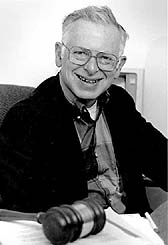
Almost 20 years ago, Professor of Politics Fred Greenstein helped change the way historians viewed Dwight D. Eisenhower.
No longer would historians know Ike as a passive, sleepy head of state. Greenstein's book, The Hidden-Hand Presidency: Eisenhower as Leader, portrayed him as a shrewd operator who worked behind the scenes to accomplish his agenda. Now Greenstein is applying the same sort of analysis to the 11 most recent American presidents and drawing conclusions that are likely to be useful to whomever occupies the White House next.
Greenstein's new book, The Presidential Difference: Leadership Style from FDR to Clinton (The Free Press), offers lessons for presidents, their inner circles and the voters who put them in office. In the book, which will be available in bookstores by May, He analyzes the leadership qualities of the modern presidents and rates their performance in six areas: communication, organizational capacity, political skill, vision, cognitive style (how the president processes information) and emotional intelligence (which Greenstein describes as "the president's ability to manage his emotions and turn them to constructive purposes, rather than being dominated by them and allowing them to diminish his leadership").
Rarely--if ever--do presidents excel in all six, Greenstein said.
Nixon: emotionally impaired
FDR had superb political skills, but his selfassurance and powerful personality were hindered by an organizational style that pitted his advisers against each other. Ronald Reagan may have been "astonishingly uninformed" about the specifics of his programs, but his strength as a communicator and performer helped compensate.
Even Gerald Ford, the amiable butt of jokes, can provide a lesson to today's presidential hopefuls: He was a strong manager who "had an impressive capacity to withstand the pressure of office," Greenstein writes.
Greenstein's look at Richard Nixon portrays the "most emotionally impaired" of the presidents, with anger and suspiciousness that reached Shakespearean proportions. However, Nixon was graced with a wealth of strategic intelligence, which helped him rack up major foreign-policy successes in his first term.
Clinton: underachiever
In Bill Clinton, Greenstein sees a "politically talented underachiever"-- a politician who moves listeners to tears with some addresses but rambles and steps on his own lines in others; a man of great ability but tremendous emotional shortcomings. Clinton's White House experience, he writes, "provides a reminder that in the absence of emotional soundness, the American presidency is a problematic instrument of democratic governance."
In that, Clinton is not alone. Greenstein writes that Jimmy Carter's "defective temperament contributed to making his time in office a period of lost opportunity," while other Presidents with volatile tempers--Johnson and Nixon--presided over two of the most troubling episodes of 20th-century American history: the escalation of the war in Vietnam, and Watergate. In his look at emotional intelligence, Greenstein finds only three modern presidents who seem fundamentally free of distracting emotional issues, and they are all Republicans: Eisenhower, Ford and Bush.
Politics and psychology
Greenstein's book culminates a half-century of studying the presidents. It draws on the observational skills he learned during an early flirtation with journalism and his longtime interest in melding politics and psychology.
He won't predict how Al Gore and George W. Bush would govern, but he suggested that both candidates could take some lessons from past presidents. For example, he said, both should study Eisenhower's successful management style and take some coaching in communicating with the public.
But the candidates may take heart: Skills can be learned. Reagan, a former actor, understood the importance of staging and allowed professionals to manage his speeches and appearances. He and the other two presidents known for their communication skills, Roosevelt and John F. Kennedy, rehearsed their presentations and improved over time.
Brilliance not required
What about those traits that hard work can't easily change, such as cognitive style and strategic intelligence? Here again, the candidates need not despair. After all, two presidents Greenstein characterizes as "marked by cognitive limitations"--Harry Truman and Ronald Reagan-- had major policy accomplishments, while those with keener intellects--such as Jimmy Carter--fell short.
"You certainly want intelligence in a president, but the record doesn't indicate that a president needs to be brilliant," Greenstein said. "We have had some presidents who have done quite well who were not mental giants."
Greenstein, who is on leave from teaching this year, has been a member of the faculty since 1973.
top