From the Princeton Weekly Bulletin September 29, 1997
Do we need to know?
Sloan Foundation grant funds professors' research into concept of unknowability
By Carol Carlson
 Most
people are aware that water boils under certain conditions and at a
certain temperature, and this knowledge makes boiling a predictable
and controllable phenomenon. But even scientists do not know the
detailed movements of every molecule of boiling water in a kettle.
That level of detail is unpredictable, unknowable--and probably
unimportant.
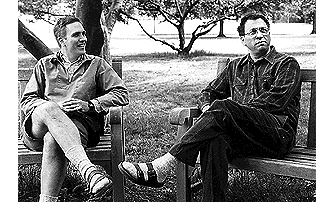
The movement of water molecules is just one example of the intriguing concept of unknowability--a concept that Simon Levin (r) and Stephen Pacala, professors of ecology and environ-mental biology, will be exploring during the next two years, thanks to a grant from the Sloan Foundation.
While unknowability is the least familiar category of knowledge, it is a partner of two much more commonly understood categories -- the known and the not-yet-known. Most people intuitively understand, for example, that while researchers have been making discoveries at an increasingly rapid pace about our world and how it works, what we know is still vastly outweighed by what is yet to be known. But how many of us have considered whether some things are, in fact, simply beyond reach?
Research into unknowability, Levin explains, is an attempt to determine how much detail scientists must ascertain about a subject to make valid predictions about it. For Levin and Pacala, who analyze the responses of forest ecosystems and grasslands to climate, the specific goal of the research will be to determine how much detail they may be able to omit from their computer simulations without affecting the validity of their predictions. Some 10 other research teams across the country have also been awarded Sloan Foundation grants to study unknowability in such disciplines as oceanography, mathematics and philosophy of science.
How robust patterns emerge
"What we're doing is trying to build a bridge between the detail at the individual level and the collective dynamics, to help us understand how robust patterns emerge from fine- scale detail," says Levin, who is George M. Moffett Professor of Biology and director of the Princeton Environ-mental Institute. "It's the same issue that meteorologists face in predicting the weather. They can understand the statistical patterns on a broad enough scale to make predictions about the climate, but at a day-by-day level of detail, they can't tell you much in advance exactly when the warm days or the cold days will occur."
In studying forest development Levin and his colleagues have created a computer simulation of a northeastern forest in Connecticut. The simulation includes data detailing the location of every tree, exactly how much light and shade each tree gets, and hundreds of other factors. But the researchers found that with so much detail, the slightest error is magnified in the simulation's predictions. Locating one tree in the simulation in the wrong place, for example, has a far greater impact on the predictions than it would on a real forest.
"That type of discovery led us to recognize that much of the detail we were trying to include is unknowable and misleading--not to mention uninteresting. But information about the collective forest is knowable and, we hope, interesting. So we're trying to understand what details of fine scale we can throw away and what is essential," Levin says.
Capturing the essence
"There are many people who believe that the more and more detailed model you build, the better your predictions will be, but our work tells us that may not be the cleverest place to put your effort, that maybe we should be looking for more simplified models that capture the essence of the system. What we're really asking is at what scale things become predictable."
Using their grant, Levin and Pacala plan to simplify many different aspects of their model.
"We're trying to get to the essential aspects of the system's dynamic," Levin says, "aspects we feel are knowable, and get rid of the seductive but misleading extra detail." By eliminating unnecessary, unpredictable and unknowable detail, the scientists hope to improve the accuracy of their predictions.
Both Levin and Pacala joined the EEB faculty in 1992. Levin came to Princeton from Cornell, where he held an endowed chair and directed the Center for Environmental Research, and Pacala from the University of Connecticut, where he was an associate professor.
Photograph by David Wurtzel