From the Princeton Weekly Bulletin September 29,1997
Cool in summer, warm in winter
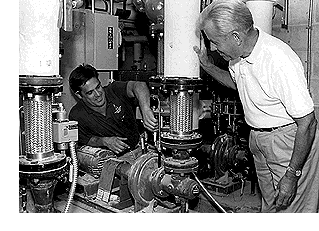
HVAC manager Joe Flatley oversees temperature regulation systems in 55 buildings and 37 dorms on campus
By Caroline Moseley
 He
keeps us cool in summer and warm in winter. He is Joe Flatley,
manager of HVAC (heating, ventilating and air conditioning) trades
for Grounds and Building Maintenance (r, with Steve Deleo).
The HVAC unit, Flatley explains, is composed of three shops: HVAC, HVAC Controls, and Air Conditioning and Refrigeration.
"The HVAC mechanics (who were known as steam fitters until the mid-'70s) install and maintain the pipes, pumps and fans that heat and cool campus buildings. HVAC control mechanics install and maintain the controls for those heating and cooling systems. The air conditioning and refrigeration mechanics take care of Dining Services, walk-in refrigerators, and water coolers and window units."
All in all, says Flatley, the HVAC trades are responsible for "55 buildings and 37 dorms, mostly on the main campus."
Systems don't change overnight
All campus buildings are heated by steam from the Co-generation Plant, Flatley says. The steam, after being piped underground to individual buildings, is converted into hot water -- "hot water for heat," he emphasizes, "not hot water for bathrooms or laundry rooms." (The latter is supplied by water heaters in each building, a joint endeavor of the HVAC and Plumbing shops.)
Campus cooling originates in the Chilled Water Plant, "adjacent to the Co-gen Plant," Flatley continues. "Water is piped to each building through an underground network separate from that used for heating. The chilled water is circulated through coils that are part of the air handling system of each building."
The actual temperatures maintained, he points out, are not established by the HVAC shops but by the computerized maintenance management system in MacMillan, operated by Engineering.
The busiest time in the HVAC shops is "change-over between seasons: the fall, when we start heating, or the spring, when we go into air conditioning." Systems don't change overnight, he notes. "It takes an average of three weeks to get the campus ready for winter operation or for summer operation. There's a lot of manual valving -- opening and closing valves from cooling to heating or vice versa -- which is all done in individual buildings." Though the timing of the change-over depends partly on weather, "On average it comes in the second or third week in October."
Flatley was born in Long Branch to Irish immigrant parents who decided to return to Ireland when Joe was three years old. He grew up in the village of Castletara, County Cavan, and graduated from Cavan Technical School. In 1957 he returned to the United States, worked briefly with an uncle in Boston and spent two years in the U.S. Army serving in a motor pool at Ft. Benning, Ga. Upon discharge, he returned to Boston but soon moved to New Jersey when his mother decided to settle in Hightstown.
Flatley began work for Princeton in 1961 as a member of the grounds crew. Then, he says, "there was an opportunity for an apprenticeship in the steam fitting shop." After study at Lincoln Technical Institute in Newark and "mostly on-the-job training" at the University, he became shop foreman in 1979. He assumed his present position in 1984.
He remembers fondly those years of on-the-job instruction. "People wanted to get ahead, but they didn't get carried away by it. They would always go out of their way to help you, to show you things, help you learn the trades.
"The first foreman I worked under," he recalls, "would teach you one thing each day, not boggle your mind with 15 things." In the utilities field, he says, "When you're new, and you're brought into a mechanical space with no idea of what's going on, you can get confused. One thing at a time -- one valve, one safety switch on a boiler -- that's the way to learn."
Involved in new construction
Flatley says he has enjoyed passing his technical expertise on to other Princeton technicians. Part of him misses "the old days--I like working with my hands." As manager, he says, "there's less hands-on and a lot more paperwork."
However, the opportunity to be closely involved in new construction projects on campus compensates for "less hands-on" and is one of the aspects of his job he likes most. "Right from the beginning, when there is a new project," he says, "I get to review the drawings with the architects and engineers."
He mentions the addition to Wool-worth Center, which he has been visiting "every single day to see what's going on. I like to see where the pipes are going, how difficult it will be to maintain the systems--to look out for things that will benefit the people who use the building, as well as things that will help our guys when they have to work on the systems."
In the new part of the building, he requested "access doors in ceilings so the mechanics can reach the controls for the heating and AC." In the old section of Woolworth, he "happened to notice there were no lights in the mechanical room, where all the heating and cooling equipment is located. So I contacted the Planning Office, they contacted the general contractor, and they installed lights." He also lobbied for "a new air handling system, a fan system and cleaned duct work. That affects indoor air quality and will make it nicer for the people who work there."
Flatley's day begins with visits to the three shops and a preliminary chat with the foreman of each: Robert Macfarlan in HVAC, Bob Talarick in HVAC Controls, and Neil Harris in Air Conditioning and Refrigeration. "I like to talk to everyone, find out what's going on in their lives," he says. "Then we get into the work they have scheduled for the day."
In accents that -- just barely -- proclaim him an Irish-American, Flatley declares, "I love working at Princeton; I make no bones about it. People here go out of their way to help you. Sure, there have been some disharmonious times, and some bad days, but basically, you couldn't keep me away."
Photograph by Denise Applewhite